Monthly Archives: January 2014

Vae Victis Review – 2013

This new rule-set allows you to reconstruct the fighting at the time of the Civil War. The rule-set is specifically for 15 mm figures, with all bases an inch (2.5 cm) wide. This represents in reality about 300 infantry and dismounted cavalry. An artillery unit, always with an edge of an inch, is equivalent to a battery of four to six guns. In fact, the “strategic” brigade forms the base unit, consisting of about four bases on the table so one base is equivalent to one regiment. One inch on the game table is 100 yards (about 90 meters) and a turn represents twenty minutes. Note that all distances are given in the rules in two formats. The first corresponds to the bases with a frontage “standard” (one inch or so): the second in a frontage of one and a half inches (about 4 cm), suitable for example for 28 mm figures.

Practically, a unit is rated by its level. Four morale grades are possible: militia, green, veterans and cracks. Each player also has a sheet with the order of battle of his army, and for each brigade, boxes based on strengths (one box per 100 men) and efficiency points accumulated. These points are  inefficiency, stragglers, fatigue, or disorder. In fact, they have accumulated Es of combat or while traveling in difficult terrain. The E factors affect the morale and combat. Fortunately, they are possible to reduce during the game: at the end of a round, if a unit has not moved, fought or been lost it recovers 1d6 efficiency. Proper management of these issues is one of the keys to victory. It is indeed necessary to take time to know when to reorganize your command.

During a turn there are successive phases of “buy and supply,” initiative, control and movement of troops’ gunfire, morale checks due to the shooting, fighting infantry and cavalry, morale checks due to the fighting and, finally, the possibility of recovering efficiency points. Fighting is resolved with 1d20 for each “natural” result of 1 to 5, the unit loses a level of ammunition. Four levels are possible and the lowest two levels affect combat. To go back to the maximum level the unit must be in phase supply near his truck divisional supply and pass a die roll 1 to 10 of 1d20. Besides influencing the level of ammunition, during combat if a die roll is odd a crisis card is drawn. Five sheets of 10 cards are provided for a total of fifty cards. For example, a card may be drawn that shows the General of the brigade was drunk and so he and his men must charge any target in range. Another card may tell you that your Brigadier was killed at the head of his brigade. There may also be a box of exploding artillery (1D16 efficiency points for the battery). Etc.

For fighting, either shooting or melee, the principle is to take the strengths, usually by efficiency minus points, then multiply by various tactical factors (x 2 for rifled artillery short-range x 0.5 extreme range, etc..) and / or add or subtract other tactical factors (30 if the target is column -10 if the shooter has little ammunition, etc.). The end result is usually a fairly high number. For each 20 points, the target loses a point of strength. The remainder tested with 1d20.  Thus, for a final score of 72, the target loses three points of strength and must get 12 or less on 1d20 to make a fourth.  It’s simple, but it still requires some calculations.

Control of troops is simply done through distance of command that depend upon the skill of the Generals. Moreover, you will find a list of more than a thousand Generals, and, for each, their command radius and bonus it brings morale. This morale is tested also with 1d20. Note a very original feature: for an assault, the morale basis for the militia is 5, it increases to 10 for the “green” descends curiously 5 for veterans and goes back to 15 for cracks. In fact, the veterans saw the fire and are well aware of quite “lethal” nature of a charge. In short, it is paradoxically easier to launch an assault with novices than with hardened veterans (by contrast, the cracks are really able to mount an assault “on demand”). It is well thought out.

Finally, note the presence of a historical scenario the Battle of Seven Pines (31 May 1862).  A summary sheet duplex and full plastic everything. In general, the rule is interesting, medium complexity and clearly oriented “strategic level”.

Formations – The use of Double Line

As we look over Civil War books with good maps – we find the Formation of “Double Line” was very common during the last half of the war.  The formation was formed by having half of the Brigade Regiments in line with the remaining Brigade Regiments deployed in the rear but with deployment distance – not stacked close up.  In the Firebell rules, we should have a 1″ to 2″ open space between the Brigade lines (100 -200 yards).   This space was important to give the rear regiments the space required to deploy as the Brigadier ordered, also if the front of the Brigade entered into a fire fight this space limited damage to the rear support regiments.

In 1861, the Brigade officers went to war with the tactics learned from the Mexican-American War, the Brigade forming all of its regiments in line for maximum fire power. 

The tactics and terrain defined it’s use – (as a Brigadier leading 2,400 men the Brigade in line would be 1/2 mile long, could you see the end of your own formation or beyond and the threat to your flanks?)

Example, Antietam, the Union Iron Brigade, Gen. Gibbon in command, advances south to the battlefield during early dawn.  The Brigade in March Column moves off the road, forming regimental columns of divisions (2 companies wide) with two regiments in front, with two trailing behind, two long lines made up a number of company lines.  This Brigade formation of Double Line putting the unit into a battlefield formation, but not fully deployed into line yet.

AS THEY APPROACHED THE NORTH WOODS WHICH WAS IN THE FIRE ZONE OF MEADE’S BRIGADE, THE BRIGADE DOUBLE LINE DEPLOYED, TWO REGIMENTS IN THE FRONT – COLUMNS MOVING INTO LINE, THE TRAILING TWO REGIMENTS MOVING INTO LINE BEHIND THE FRONT TWO REGIMENTS. THEY MOVED AT COMMON TIME INTO THE WOODS, MOVING THROUGH THE PA RESERVES OF MEADE (passage of lines) INTO THE OPEN FIELDS SOUTH OF THE NORTH WOODS.  NOW AT THE FRONT – TWO COMPANY’S WERE SENT FORWARD AS A SKIRMISH SCREEN, THE REGIMENTS WENT TO GROUND/HALTED, THE SECOND LINE ABOUT 100 YARDS BEHIND THE FRONT LINE.  THE SKIRMISH LINE AT THE FENCE FOR THE CORN FIELD, ABOUT 200-300 YARDS IN FRONT. THE BRIGADIER HAS HELD HIS REGIMENTS IN DOUBLE LINE DUE TO THE TERRAIN (visibility) AND FOR IMPROVED MOVEMENT.

WHEN THE IRON BRIGADE ADVANCED ON THE ATTACK-SKIRMISHERS FELL BACK INTO LINE, THE BACK TWO REAR REGIMENTS WHEELED TO THE RIGHT TO BRING THEM ON TO THE RIGHT FLANK OF THE FRONT TWO REGIMENTS, NOW IN FULL BRIGADE FIRING LINE.

THE BRIGADE ENTERED THE CORN FIELD AND HISTORY.

=========================================================
BULL RUN I – LATE DAY, THE UNION IS FALLING APART –

Howard’s Brigade is sent forward, advancing south of the crossroads, moving to flank the Rebel line on Henry House Hill, working to stop the rebel advance and turn the battle.    As Howard moved up the western slope, he left two regiments in line as support and advanced two regiments in line up Chinn Ridge to the crest – his Brigade formed “Double Line”.
This formation was not stacked with the ranks closed up, but with intervals between the front and rear lines to allow the support regiments to deploy (react) as needed. 
Well, we know this turned out bad, unless your underwear is grey.   (Link for battlefield map)

first-manassas-july-21-1(2)

Why would Howard do this?  He was not certain of the situation, his flanks appeared to be in the air (no support).  The combination of the crest line and woods limited Howard’s battlefield awareness.  Howard’s attack was a cautious advance, giving him the flexible choice.  Once he could see the enemy and know their position, the Brigade would form a four regiment firing line to launch the attack.  In history, he would not have the time…

Hope these battle examples help in understanding the battlefield. 

Combat Risk to Corps or Divisional Generals

 
Chancellorsville -Spring 1863.  Another example to help understand the battlefield and the risk of leaders, Division and Corps.  Hop into the saddle to take a ride with Gen. Hooker –
Hooker has 7 Corps Generals, none were seriously hurt and taken out of action, and this was in woods with a crushed flank, we tend to think with impressions, surprising fact for this battle.  A major victory for the Southern army, yet the Northern Leadership was little effected.

Gen. Hooker had 20 Infantry Divisions, 20 Division commanders at Chancellorsville. 

In the III Corps with Sickles is Berry, (present in our Seven Pines game) he is in the woods and is in the rear but close to the action where a Division Gen. should be.  Barry is with one Brigade, has to cross a road to get to the rear of his next brigade, he is told by his staff to not expose himself.   He runs over and makes it, the other brigade is in command, things are good, he runs back at which time a rebel SHARPSHOOTER HITS HIM IN THE ROAD, HE DIES. 

Gen. Whipple in the III Corps with Sickles, late in battle, the men are digging in on the new line north of the crossroads, light skirmish fire, snipers are bothering the men, the Gen. is in the act of sending an order to get Berdan’s men to assist when a SNIPER in a tree hits him in the chest, he dies OF RIFLE FIRE.

Gen. Devens with the XI Corps with Howard, his Division is hit first by Jackson’s men, hot – chaos – bad.  Devens is up close for command and control in the heavy woods, he moves up to rally one of his brigades that is breaking, is HIT BY SMALL ARMS IN THE FOOT WITH THE FRONT LINES, wounded out of action.

Total, 3 out of 20 Division Generals, 0 out of 7 Corps Generals.
No hits from Artillery, very poor ground for artillery, short fields of fire, short-range work.
Of note is that two of the hits were from what is described as Sniper/sharpshooter fire, in the Firebell system this is represented by the random Crisis Cards.  The Artillery would play a role in just two months at the Battle of Gettysburg were Gen. Hood, Gen. Pender, and Gen. Sickles would fall from Artillery hits.

Interesting info huh?  Note, remember this is not counting the Brigade Generals/Colonels on the firing line – they die.  By giving these examples in major battles known by many, it helps to see the result compared to Firebell.


My Corps General is Superman!

In the post on the evolution of the Command system in Firebell, our focus was with the gamer/player leading as the General of a Division.   Our solution for the role of the General of the Corps was to provide help, yet to put a historical brake onto the game table.   Decisions will have to be made, the General of the Corps can not assist everyone, all the time, limits exist.

With the list of options that the “gamer” can make for decisions, the day will happen quickly and the debate can be heard “they could do more than one thing!”   True, very true.
This question could be answered before it is asked – lets ride along to see the action.
=================================================================
“The General of the Corps was surrounded by Aides, the quartermaster was reporting in on the status of the Artillery trains that had been slow on the march.   Messengers had arrived from the nearby Corps to deliver information on the coordination of their mutual flanks.   As the Divisional Generals lead their formations into position, a steady stream of riders could be seen reporting in on their situation as the battle developed, within this Chaos the Army’s General had sent a currier to secure a ‘full report’, there wasn’t enough time in the moment.
As the Corps leader conducted the discussions, he looked about, his eye was on the General of the 1st Division, he was the weakest within his command team and his deployment needed to be addressed.  The Brigade that had led the Corps into action was off to his flank with the officers desperate to rally the men that would be needed in the hour ahead.  On the other flank was the artillery reserve waiting to be ordered into position for fire support, they should already be moving into position.   His thoughts flashed back to the last action-their last battle, in a desperate moment he had left his Corps position to order one of his Brigades into a counter attack, it was risky but had saved the day.   His mind was racing….”

The shell of a enemy battery exploded nearby, it disrupted the HQ group discussion but for the Veteran General it was time for a decision, an order was yelled….

Development discussion on leadership in Firebell

This is a collection of my emails on command written in Sept. 2011 –

Have thought about this issue quite a bit the last few weeks, these kind of questions sometimes find a hole where you never knew one existed.   High command during a battle, we often read of the high command moving to battle, the deployment issues, the angle of attack, yet then what?     Gettysburg AGAIN, sorry,  many good examples.

Day 2, Longstreet’s attack at 4:00 PM> three Division commands –

Hood Div. HQ, is following the attack across the fields, in the rear where he belonged but hit by long range Artillery most likely smith’s guns on Devil’s Den, this was early in the advance.  He was out of action for the battle; aides had to find Gen. Law who commanded the southern most Brigade and was moving towards Big Round Top with his AL boys.   By the time they find him, he now has to transition his brigade command to the senior officers within his Regiments, confusion during the advance.   While Texas Brigade, under Robertson is split, half moving to the west on line with the AL boys, half drifting to the northeast.  With Gen. Hood down what has happened is the two brigades are drifting into two different attack vectors.  Gen. Law orders two of his AL regiments to swing north to fill the gap formed within the Texas Brigade line.   BOTH BRIGADE FORMATIONS ARE NOW BROKEN UP.   Gen. Law moves to take command for Gen. Hood.   The AL boy’s move into the fight, two actions form one for the south ridge on Little Round top, the other in front of Devil’s Den.

So what happened here, with the lost of Hood, and the replacement by Law, both Division and Brigade experienced Command changes in the launch of the attack, the early attack became disjointed.   With the next wave of Benning and Andersons’ Brigades this was over come.   Also to note, the Brigade that attacks Little Round Top (really half Law AL and half Robertson TX brigades) was under the command of the senior AL regiment out of touch with Division command.

End Result, the Division Command was not the same; the Brigade Command was not the same. Not good period.

Looking north to the Peach Orchard, McLaws Division, reading history you don’t hear much of McLaws.   Where was he, what was he doing, did he have any effect?   Kershaw and his SC boys were in the front wave, you read of him sending aides to Semmes Brigade in his rear, working to coordinate the two brigades actions, but what about Div. McLaws, He is not visible!

Gen. Longstreet has a large shadow over McLaws, Gen. Lee was concerned so old Pete was very close by.   He ordered artillery placement during the deployment, he is the one that released the Brigades/advancing with the SC boys under Kershaw for a short distance, and it was old Pete that stopped the attack and recalled the last attack by Wofford.

Looking North to the open fields, Gen. Anderson’s Division under A.P. Hill with five Brigades would continue the Southern attack at 6:30/7:00 PM with his five Brigades.   During the hot attack in Plum Run valley to the break thru on Cemetery Ridge by Gen. Wright’s GA boys, aides would find Gen. Anderson and his staff resting on the ground back in the woods behind Seminary Ridge, THEY WERE NOT EVEN IN ACTION, NOT EVEN WATCHING FROM THE REAR, SHOULD HAVE BEEN FIRED.   In game terms all five Brigades went into the fight out of command control, interesting heh?  Additional failure of Divisional command, Divisional Artillery is not repositioned for support as the attack breaks through.

On the other side of the field, the Union command is working like a machine, so much for the general history Gen. Lee’s army-Good command, Northern army-Bad command.

Example, Gen. Hancock’s ride during this period, he/II Corps command/ is ordering Divisions, he is ordering Brigades, he is ordering Regiments, he is ordering Battery’s, and he is in constant movement on the front lines moving over a mile on Cemetery Ridge.

Problem I will continue to work on, what I don’t like in rules systems, making the Division Command an extra fill in for Brigade command, the spare tire to fill in as needed, not correct.

================

Additional thoughts this afternoon, standing with the Union Command July 2nd, 1863—

What is the command Radius of Corps?

What Decisions can a Corps HQ make?

Is the Decision Limit based on ability per turn, a piss poor Corps (1 action/order/decision/ per turn), a good Corps maybe 2??

Note 100% correct, thinking out this; going from memory, what does the game model; do we place the gamer in the same decision box?  Got to love, Multiple Choices, but limits on how many one can make, pick wise……..

III Corps Sickles MADE the decision to advance to the high ground at the Peach Orchard, Corps Command is required for a division to move or to be placed, Corps level….  Divisions were given direction, not 100% rule, but damn close.

III Corps HQ staff with both Division Leaders place the artillery battery’s, High level (Corps and Division HQ) decision by 1863 AOP. (Additional point, the battery would unlimber by a brigade/regiment for support, but the direct/decision for placement was made by upper Command)

III Corps Sickles made the decision to transfer a Brigade from Humphrey’s Division to Birney’s Division, Corps Level Decision.

(Note, done by regiment piece mill, but with Grand tactic system, based on the whole Brigade.)

III Corps Gen. Sickles effect to rally men early in action.

==========================================

V Corps Sykes

Sykes leads his Corps to the South to reinforce Sickles III Corps, ordered by Army command.

Sykes makes decisions on the ground how to deploy his Divisions, breaks up some to send separate Brigades to Little Round top.

Sykes is not in Heavy action, but in the rear guiding troops to where they are needed, which was his job.

Key, Corps Command is placing units giving the Direction of movement.  Command points/value are spent in making another decision as each unit arrives in March column – this is good.

Late in action, Wheatfield, Sykes?Staff? Gave ok for the Brigades in Trostle Woods to reenter the Wheatfield to support Caldwell when his division was pressed.    V Corps/Division HQ, (Barnes? not sure) was there within radius, key point…

==========================================

II Corps Hancock

Hancock had moved one of his Divisions South about 500 yards at 1:00PM – about 4:00 or 4:30PM he is ordered by Army command to move a Division south to support the flank.  Army/Corps HQ decision.   The Division under Caldwell was in reserve had moved south by the flank, the regiments were stacked by brigades.   Interesting Point from John Simmons, this Division moved on the reverse slope, we shit history for Wellington and the reverse slope, yet at Gettysburg, little noticed.  Gibbon had Webb’s Brigade in reverse slope as well.  I think Willard/Hays Division moved done the reverse July 2.  The east side of Cemetery Hill is a broad slope, good ground to move men on, not as steep as the west side, wider as well.  II Corps Hancock is not with Caldwell at the South end of the ridge; Caldwell takes his division into action as ordered before.  Hancock-Decision- had set the direction and the movement.  This was Hancock’s old Division, a good one….

III Corps Divisions

Birney was stretched out – units out of reach. Command issues, Radius?? Coordination became impossible.

Took command of Brigade sent by Sickles to fill the line, -Division Decision

Birney worked to hold the line/Rally the men, Division Decision, later failed to rally what was left.

Humphreys’ on Emittsbury Road, only two Brigades, fought hard, rally to hold the line, controlled the artillery Battery’s – Division HQ decisions.  Late day, organized chaos in retreat, did rally the 2 small brigades at the ridge and was able to assist in the late day counter attack.  One Brigade had about 150 men, the other maybe 300, very small.

————————————————-

 The Brigade ratings [1-6] from Todd Fisher work well, we could review as needed.
Artillery, to unlimber an Artillery Battery it would have to be placed by a senior officer – Division and Corps.
Division and Corps rated as 0,1,2,3 by labels we discussed
—- The action by a Division or Corps command should count as a command action.
Artillery was a second class to infantry, many artillery officers would move to infantry command to get promotions.  —- The officers of a Division from another Corps cannot order another Divisions guns around, Command Friction.  Sorry!   If within the OOB, guns were part of a Corps reserve, the Corps or ANY Division leader from Corps could place them.

—- Interesting Idea,— this could be scenario rule addition for early war ’61 and ’62, Artillery were assigned to a Brigade, the artillery would have to be within a defined range of the brigade for supporting it {it’s parent brigade}.   Old Mexican-American style OOB, Limits gamer…
The reason for this is to show how the organization of artillery mattered, how it would affect the battle fought.  Interesting to fight this way, then fight a later battle where artillery has more freedom to move and mass.

I strongly believe you need to have leadership within the system, as to optional rules, make the leadership rules standard and add the option for all leaders to be rated the same, maybe Able and Tolerated for new players learning the system or for a head’s up more competition type game.

The Civil War attraction is the cast of characters found in the pages of our history.

The values of two sets, Management and Morale – I support this, very good.

One is the combination of administration, could be Tactical skill of leading and Multi-Task management.  Give’s you terms to think as to how to describe this.

Morale separate, like this, there are guys that were good at tactical but the men would not fight well for them, it can cut both ways.

Good stuff, as to the ranges, have to playtest to tune this function.  From our talks you see the avg. gamer handling a Division, 4 to 5 brigades.   I think with experience this could be a Corps and it would work.

============================================

Working on the Shiloh OOB tonight, thinking on this very thought, I really like this leadership.

For the South you have old reliable Gen. Hardee,  “Efficient and Respected”

But of Course you also find Braxton Bragg, a “Hapless but Tolerated” General!

Sounds good.  I used the same tables for the Corps and Army as well, I think it will work; to have a different table would be very confusing to the gamers.  At Shiloh we have Gen. Albert Sidney Johnston a “Able and Respected” army commander, assisted by the hero of Bull Run, P.G.T. Beauregard, a very “Efficient and Respected” General!!

Lots of really bad leaders in the spring of 1862, wow.

P.S., I also have been writing down the Brigade Leading value for Division Generals, to put on the OOB in case they grab the colors and try to lead the men into battle if things start to go really bad.

I.E.  Old Hardee, the man that wrote the book, (Hardee’s Light Infantry Tactics) is a (4) – a better then avg. fighter; some of the Brigade leaders are not on the list, now going to the books to read up on their actions.

Union Example, the author Gen. Lew Wallace, between Ben Hur chapters he is seen as “Able”, but if leading the fight, a (2), He was heard to say, “I’m a writer, not a fighter!”   But of course not all is lost, old Crazy Sherman is very “Efficient”, and a real fighter (5) when pushed around.

=========================================================================
Corps is a difficult thing, if the player is a Division leader, to model command above the player, you cann’t build alot of restrictions or you leave the game world for the simulation, no fun for most.
Current thought is to have the Corps help the Division command, identify the positives that a Corps leader could assist a Division command, but not to build in the restrictions, I don’t believe you want that.  (-command points,  -chits  I Don’t think you want to go here..)
I’m thinking and working on this,  Corps would launch the advance and the attack, these functions would be built within the scenario for attack or when a Corps arrives onto the field of battle, agreed?  The Corps is managing his Divisions, working to see they are doing what he thinks, (we are letting the gamer do the thinking).
But, also the Corps General is giving orders – ADVICE – I had written before on this, so repeation what do you think of a Corps commander able to assist a Division General, this is the personal touch.   Note my Gettysburg article on Division McLaws and Gen. Longstreet as Corps is glued to his ass…  In game terms, maybe this moves the Division radius up on grade, the Corps General and his staff are on TOP of the Division to make sure they do ….
In game terms, three Divisions in battle, all calling for the Corps Generals attention, come help me???
Also, Corps could place Artillery Batteries that are needed for support, the placement might be outside the Division General support, maybe the Division is advancing, the Corps General is to the rear and guiding the support Artillery placement as they come into action.
Here again, players/gamers would see the role.  Lastly, a brigade in trouble, running to the rear, the Division General is still up front supporting his remaining brigades, the unit has routed outside of the Division radius; the Corps General moves over to step in the middle and rally the boys to reform the line!!

Friction in Battle – Fatigue, Disorder, and Shaken

per the question from a gamer-
“how is fatigue handled under these rules?”

The Brigade or Battery will pick up fatigue from movement, formation changes, firing, and melee. This is in the thought process of the Friction of battle, it could be looked at as physical – the men are tired, stragglers – men increasing falling out of ranks, equipment – gun barrels are fouled, cohesion of the unit – officers are losing control. This friction is measured in the game by the term Efficiency Points. These directly reduce the fighting strength of the Brigade/Battery. If the Brigade/Battery has the chance to reform for a turn, i.e. not in combat, the Brigadier can attempt to restore order, how much is not known.  An example would be during the Pickett/Pettigrew charge on July 3 at Gettysburg, as the rebels advanced they entered a swale about half way across the field, this allowed the unit to halt and officers to reform ranks, close ranks, collect straggers etc. from long range artillery fire, the officers cry “take a breath men”.
For the artillery crews, the act of firing the battery for a turn causes this lost as well, with the risk of ammo and the physical effect, it is not uncommon to see a battery rest for turn vs. the game where we just fire away.
Another example in a recent game, 1st day of the Seven Days at Oak Grove, Virginia; Gen. Sickles moves his brigade across White Oak Swamp, it is heavy rough, slows the unit down, Gen. Sickles is pushing to clear the wet land and reach the higher ground.  He orders the unit at the Double Time, the unit is hit hard by E-factors, he gets the ground but is in bad shape. The Rebels under Gen. Huger advance into a Skirmish fight which does not allow Sickles to reform, he now is in a bad spot.  During the next turn, with the brigade in trouble, it fails morale, falls back over the stream, and picks up more e’factors in the process. It will take time to reorder the unit, although it has very little strength point loses it is wrecked due to friction. With luck and good officers Gen. Sickles Brigade will recover and could re-enter the battle in an hour.

Gettysburg July 1st Scenario in testing

July 1st, 1863 Morning at Gettysburg

This scenario is in play testing, the battle for Seminary Ridge.

The fight for Gen. John Reynolds I Corps to hold the ground while the Army of Potomac rushes towards the town of Gettysburg.  This is an unusual situation as the game opens with just two Cavalry Brigades under Gen. John Buford holding the ridges west of the town for the Northern Army.   Gen. Henry Heth’s lead Brigades are just arriving over Marsh Creek and are pushing back the Union Cavalry on Herr Ridge.  The game has a lot of movement and deployment not seen in many Civil War games.

With Gen. Buford's Cavalry under pressure, the I Corps is Double timing across the fields, here we see the Iron Brigade moving to the NW.

With Gen. Buford’s Cavalry under pressure, the I Corps is Double timing across the fields, here we see the Iron Brigade moving to the NW.  The command label shows I Corps/1st Division – Gen. Meredith Leading Combat factor of 2, the Brigade is 1900 men strong and are a Crack Unit!

Gen. Henry Heth has taken Herr Ridge and is bring up his Artillery Battalions to open up on McPherson's Ridge.

Gen. Henry Heth has taken Herr Ridge and is bring up his Artillery Battalions to open up on McPherson’s Ridge.

All the figures painted and modeled by Dale Wood, Pictures by Dale Wood.

The guns at Gettysburg

The Guns at Gettysburg –  This information was used for A Firebell in the Night discussion –

Deployment-engagement distances found during the three day battle –

Gettysburg presented a very open field for a Civil War battle –

Day 1

Herr Ridge to McPherson’s farm 1,300 yards

Seminary Ridge to West McPherson’s ridge/Perrin Brigade 600 yards

Seminary Ridge to East McPherson’s ridge/Scales Brigade 300 yards

East side of Oak Hill/Rode’s guns to Union/Dilger’s Position 1,230 yards

NE York Ave/Early’s guns to Barlow’s Knoll 1,000 yards

Day 2

Culp’s Hill to Brenners Hill 1,000 yards

East Cemetery Hill to Brenner’s Hill 1,500 yards

East Cemetery Hill to Brenner’s Hill the north end 2,000 yards, Position of 20# Parrotts

Hood’s Position on Warfield Ridge to Smith’s Guns on Devil’s Den 1,333 yards

Warfield Ridge to Little Round Top 1,667 yards

Wheatfield Road line to Rose Farm 500 yards

Seminary Ridge/McLaws to Peach Orchard 666 yards

Seminary Ridge/McLaws to Plum Run 1,500 yards

Trostle House/Bigelow Position to Peach Orchard 666 yards

Smith’s section Valley of Death to the Slaughter Pen 1,500 yards

Seminary ridge to Cemetery Ridge 1,333 yards

Seminary Ridge to Cemetery Hill 1,500 yards

Seminary Ridge, North, to Cemetery Hill 1,733 yards

Powers Hill to Spangler’s Spring 1,000 yards

Steven’s Knoll and East Cemetery Hill vs. Early 670 yards and less

Day 3

Rogers House/Emitsburg Road to II Corps 850 to 1,000 yards

Powers Hill to East Culp’s Hill 1,200 yards

Longstreet’s Guns on Emitsburg Rd to Union/McGilvery gun line 1,330 yards

Daniel’s/McGilvery line to the flank of Kempers line 666 yards

Seminary Ridge to Cemetery Ridge 1,333 yards

Seminary Ridge to Cemetery Hill 1,500 yards

Seminary Ridge/North end to Cemetery Hill 1,733 yards

Cemetery Ridge/II Corps Guns Canister opened at 350 yards

-without shot or shell had to wait for Canister Range, 3” rifles.

The Battle of Seven Pines, May 31 1862

This scenario is included within the rules book –

Day 1 at Seven Pines, with the Union Army at the gates of Richmond, VA, Gen. Joe Johnston sends his Rebel Divisions to attack Gen. McClellan’s Divisions south of the flooded Chickahominy River.  With the Southern men on the march early it is the opportunity that Gen. Johnston has waited for, to bring mass against a smaller portion of the Union Army.

The battle develops into two separate actions divided by the east/west railroad line with the northern field often called the Battle of Fair Oaks.  CSA Gen. Smith attacked to break through the flank of the Seven Pines lines only to run into the Union Division of Gen. Sedgwick’s men rushing to battle.

CSA Gen. Smith sending his brigades into action at Fair Oaks Station.

CSA Gen. Smith sending his brigades into action at Fair Oaks Station.  CSA Whiting Division marker can be seen.

South of the Railroad line, the Rebel Division under Gen. Daniel Harvey Hill attacked the light works of Casey’s U.S.A. Division line at Seven Pines.

At Seven Pines, the Division lead by CSA Gen. D.H. Hill attacks the prepared works.

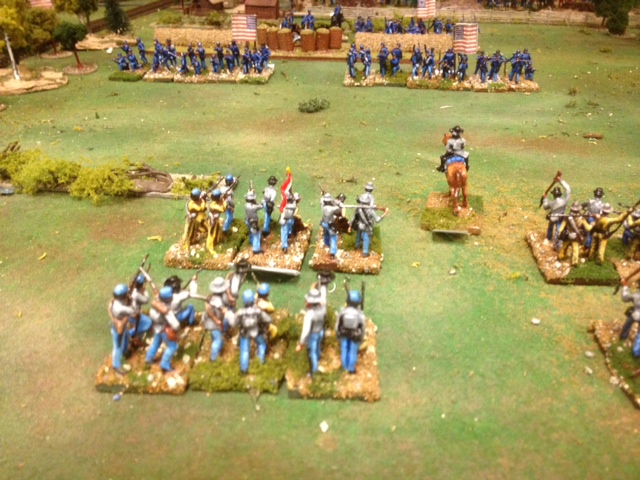
With Seven Pines in the distance, Gen. D.H. Hill’s Division attacks the prepared works – the Brigades advancing in Double line.

The Rebel Brigades Assaulting the Union lines.

The Rebel Brigades Assaulting the Union lines.

Late in the day, the Rebel line has overwhelmed Casey's Union line.   Kearney's Division has moved up and is contesting the field.

Late in the day, the Rebel line has overwhelmed Casey’s Union Prepared line. Kearney’s Union Division has moved up and is contesting the field.

The Scenario has the Rebels hitting hard all along the front, but with Union reinforcements, a stiffening line stops the breakthrough.

Battle of Glendale, June 30 1862

Battle of Glendale or Frayser’s Farm, After Action Report (AAR)

New Scenario in Development – The battle will be in the coming Scenario Booklet.

The battlefield view from the Rebel rear

The battlefield view from the Rebel rear

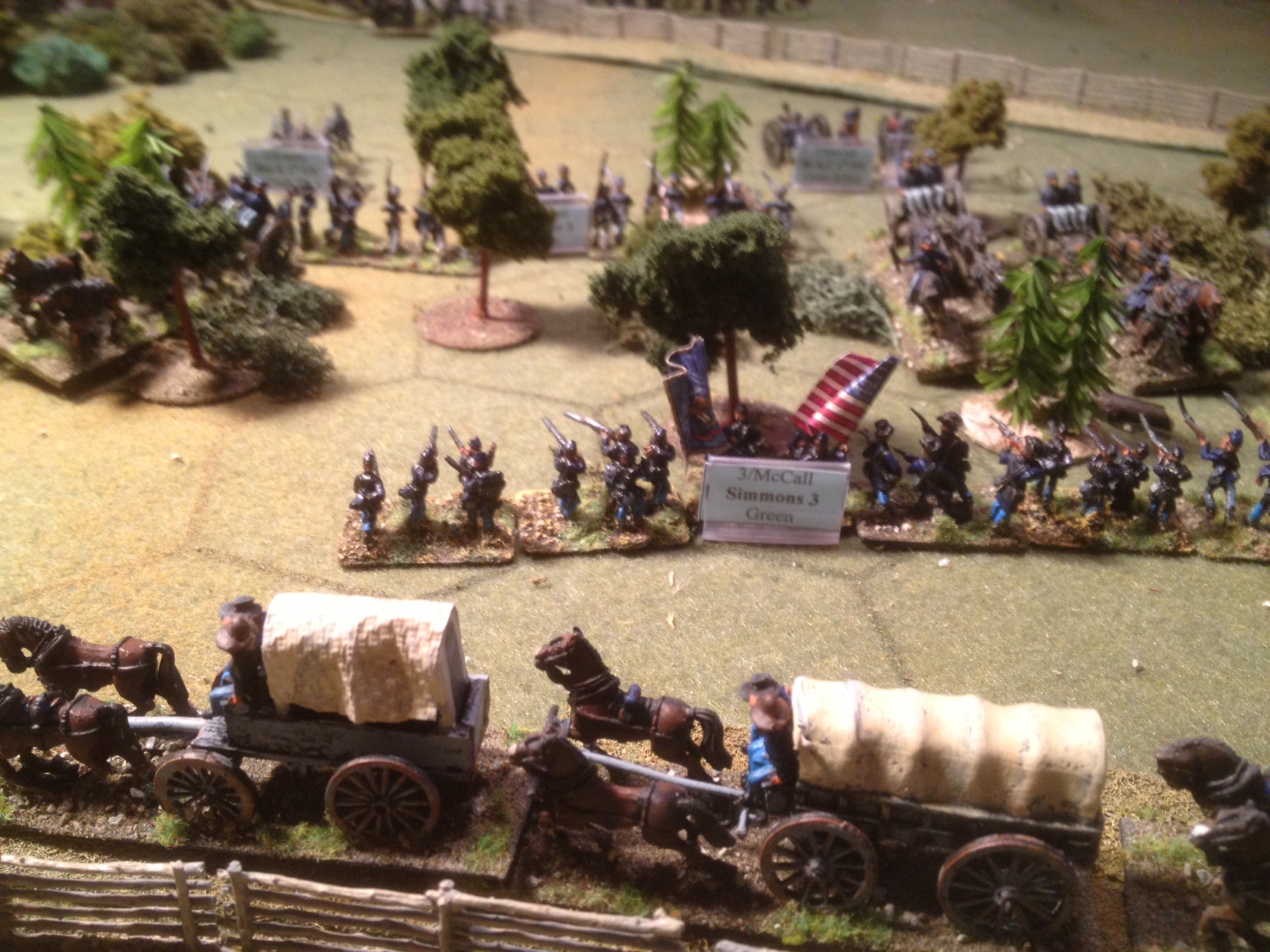
The view from the rear of the Union Center, The Gen. McCall's Division within the light woods supporting the Artillery

The view from the rear of the Union Center, The Gen. McCall’s Division within the light woods supporting the Artillery

meade

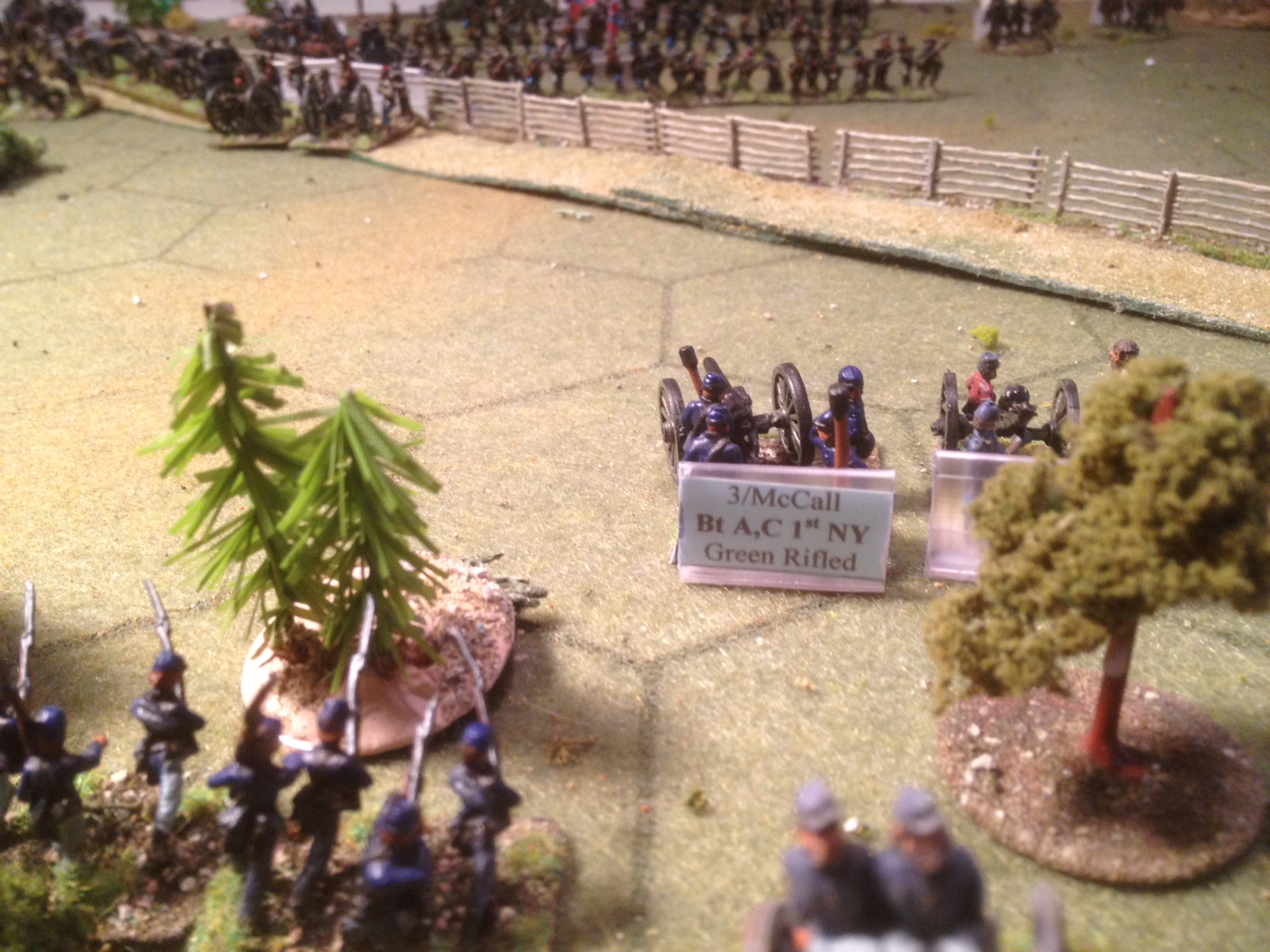
The Union guns positioned in front of the Infantry Brigade lead by George Meade, positioned within the light woods.

CSA Artillery moving forward to unlimber prior to the attack.

CSA Artillery moving forward to unlimber prior to the attack.

The placement of the Union Artillery in front and with the woods behind them would lead to many of the batteries being overrun during the fight.

The placement of the Union Artillery in front and with the woods behind them would lead to many of the batteries being overrun during the fight.

The Rebel Brigades having smashed McCall's Division break the Union center to reach the critical road in the rear.

The Rebel Brigades having smashed McCall’s Division break the Union center to reach the critical road in the rear.