Monthly Archives: February 2014

Double Line use in the East – 1863

Reviewing the battles of The Army of Potomac and the trend for Brigade Double Line to be used more often.  The use of Double Line provided a quicker response time to movement, better command and control in the heavy woods found on many of the battlefields.   It was used as a defensive formation when facing the unknown or when in close support.   Within the Firebell rules this is how the system models Double Line.

Example – Battle of Chancellorsville on the first day, May 1st.  Union/Sykes Division has all three Brigades in Battleline for an offensive probe (Ayers/Burbank/O’Rorke), Union/Hancock Division is in rear support, he has his two Brigades (Caldwell/Zook) in Double Line within the woods as a strong defensive second line.    On the southern flank, Willams Division also is holding a defensive position, he has the Brigades (Ruger/Knipe) in Double Line within the woods.

Chancellorville[Clip of Maps from the Civil War Trust]

A review of Gen. Lee’s advancing Rebel’s, the front Brigades are in Battleline for max. offensive impact, a Brigade lead by Kershaw is in support positioned in Double Line to allow for a quick response/movement.  McLaws is leading his Division onto the field, he is moving to the northern flank, he forms up with his central Brigade in Battleline, with a supporting Brigade in Double line on each flank, also in woods (the use of Double Line to protect against a possible flank attack).  ======================================================================

Now we look at Gettysburg on the Morning of July 3rd Dawn.   Gen. Ewell/Corps has moved additional Brigades into the renewed fighting at Culp’s Hill, reorganized now with Johnson’s Division.    Within the Woods below the steep Culp’s Hill, the Rebel Brigades (Jones/Williams/O’Neal/Walker) are attacking in Double Line in the difficult terrain.

Culp's HillOn the lesser hill, two rebel Brigades (Steuart/Daniel) attacked in Battleline, with Smith’s Brigade on the Division flank in Double line as a strong anchor.   The action around Culp’s Hill is one of the few places during the three day’s of fighting around Gettysburg that the formation of Double Line can be seen.   With the gentle slopes and open fields, Battleline was the most common formation used.

With Sumner’s Corps at Antietam

The Battle of Antietam – September 1862, a Grand Tactical review. – (maps Civil War Trust clips)

Gen. McClellan attacks Gen. Lee’s lines, at Dawn the I Corps lead by Fighting Joe Hooker pushes the Rebels in the Cornfield, the East and West Woods.  Late in the morning the II Corps lead by Gen. Sumner arrive and deploy just out of the East Woods.   The Brigades deploy as they arrive after crossing at the north bridge, forming Brigade Lines.   Sedgwick’s Division is the first in the march column, Sedgwick’s Brigades (Gorman, Dana, Howard) form up with only 40 paces/25 yards between each Brigade line.   Gen. Sumner advances the Division into the East Wood and through into the open fields.  Gen. McClellan was expecting Gen. Hooker to coordinate the actions of the II Corps, but arriving onto the field Gen. Sumner could not locate Hooker as he had just left the battlefield due to his wounds.   A history “What if”, had Hooker been present to give Sumner the proper attack vector.   Sumner missread the battlefield – he had believed that the Union had secured the northern battlefield, he marched out with Sedgwick’s Division to enter the West Woods then to wheel the Division South and roll up the Rebel line.  As Sedgwick’s Brigades advanced they spread out to 75 paces/45 yards between the lines, but as they entered the West Woods, they closed up again to only 40 paces/25 yards apart.   Packed into the West Woods, there was no room to wheel or redeploy the units, once under fire, attempting passage of lines, attacked in front and on flanks it lead to disaster.                            (the formation was similar to Upton’s attack in May, 1864).

Sedgwick Division

The second Division of the II Corps had arrived, deploying into Brigade lines.  Gen. French could not find Gen. Sumner, Sedgwick’s men were hidden in the West Wood, and with French misreading the fighting around Dunker Church as his Corps, he set his attack vector angled to the south.

French’s three Brigades (Weber, Morris, Kimball) hit the Rebel line along the Sunken road, going into action piecemeal, as one was replused the next brigade advanced with passage of lines to attack and with all of his brigades stalled against the rebel lines, it was Sumner’s last Division lead by Gen. Richardson that arrived.

Gen. Richardson advanced to support French’s Division left flank,  his Brigades in line contacting along the lane that is remembered today as “Bloody Lane”.  Meagher’s Irish Brigade hit first and needed support by Caldwell’s Brigade, with Brooke’s Brigade moving thru (passage of lines) to finally break the Rebels.

Of note, the artillery is assigned to each Division at the time of the battle, Sedgwick’s guns unlimbered on the southern flank of his advance, they formed the hinge between him and French’s Division moving to the south.  The guns of French and Richardson did not have ground to unlimber on as the Rebel lines were just behind a crest line, this ridge gave cover as the Union Brigades used passage of lines as each made their attack.

Richardson Division

In game terms, all Brigades advanced and fought in Brigade front/Battleline for maximum firepower/shock.   Multiple examples of passage of line are seen, with many not successful under fire.   Division command control is seen as the Division leaders get their units in close support to manage their attack, with Gen. Sumner not near he provides no assistance to French and Richardson.   Sedgwick’s guns provided good support, as the game system should support the proper use of the guns, looking at the battle one does not find the Division guns being used outside the zone of their Division Leader.   One great insight into this tactical view is from Tidball, one of the battery commanders within the Horse Artillery Reserve.   He would write after the battle, what if the 24 guns within the Horse Artillery Reserve had been ordered forward to deploy onto the ground near Dunker Church during that key window when the battle stood in the balance?  Gen. Henry Hunt had only been Chief of Artillery for a short while, he had served The Army of Potomac very well, the guns created a killing ground here, but Tidball’s thoughts would be put into action by Hunt at Gettysburg.

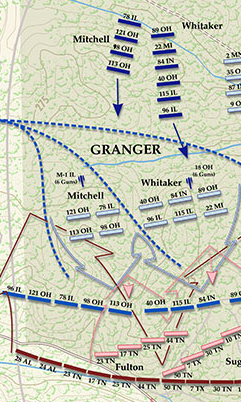
Interesting comparison, the Battle of Chickamauga in September 1863, one year later.

Tactics have changed, note the Union Brigade Formations – Double Line use in 1863 –

Thomas

Granger

Game Table Introduction Sheet

The following document was created as a handout for new gamers to read as an introduction to A Firebell in the Night rules.  With the player assigned to Divisional command, the player is put in the position of having a briefing by his new Corps Commander.  The key game terms are in Bold text to provide a quick start up for understanding the rules.

Introduction game sheet

Review in Miniature Wargames #363

Review by Paul D. Stevenson in issue #363, Paul is well known for his Civil War Scenarios –        1/2 of review used due to copyright.  –

“The rules come in an A4 softback cover with 54 glossy pages, some in color.  Of this total, ten pages feature the Battle of Seven Pines and twenty pages are given over to rating every commander (over 1,000) in the Civil War.”

“There is no index, but the rules are nicely laid out and easy to follow.  The illustrations are from Battles and Leaders…”  (There is an index/ the Table of Contents is just before page 1 of text)

“Also included is a glossy card playsheet and five A4 sheets enabling the gamer to cut out 50 ‘crisis cards’ which are drawn during play to cover random events that might influence the battle.  Some preparation is needed to play and records are kept of a unit’s supply status, ‘diminishing’ brigade strength and fluctuating battle efficiency – not to onerous. ”

“I do like the way skirmishers have been accounted for in assessing casualties – they are represented in the abstract, but when battle lines get to close quarter, their presence as a screen is removed with an inevitable increase in casualties.  Command functions have a part to play and the commanders have characteristics and a radius of influence.  They can be hit, too – though (inferior) replacements can be made.”

“If the title seems a little obscure, the rules seem pretty much spot on in presenting a good simulation of large scale ACW conflict and is represent an alternative to the popular Fire and Fury set, also aimed at brigade level.”

Union Leadership losses at Antietam

Union Leadership at Antietam, the bloodest day, a firestorm if there was one.

Profile for the day.  6 Corps leading 15 Divisions during the battle – 21 command bases —
Two Corps Generals were hit out of the Four in heavy action, Mansfield, shot by rifle fire and killed, Hooker shot and out of action.
    So what happened with Mansfield, this was his first major action, had been promoted with only coastal small actions, back water, this was his first real fight, GREEN yet leading a Corps.   As his Corps moved toward the battle, they moved into the East Woods,with firing heard ahead, HE MOVED TO THE FRONT THINKING IT WAS HOOKERS I CORPS MEN, to tell his men it was Union  fire.   It was Southern Rebels hidden in the Corn field, opened up, first volley.   EXAMPLE OF SURPRISE FIRE, HIDDEN UNIT. A weak Corps at the front..
In the Firebell system, Crisis Cards are drawn, with Gen. Mansfield a weak leader dealing with visibility in the woods, he is up close working to maintain Command, within the fire zone.
   Gen. Hooker was shot in the foot with rifle fire, he was forced to leave the field due to blood loss.   No other Corps Generals were hit.
Three Division Generals were hit and out of action.
   Gen. French leading his division close up behind his brigades, action was hot, he is there directing units, has two horses shot out from under him, the second not so good as he can not get out of the saddle quick enough and the horse lands on him, he is out of service for over a year, but returns in 1864.
  Richardson, Michigan’s own!  Richardson is at the Bloody Angle, it is a blood bath for his division, he is in the rear, but at an Artillery Battery directing fire onto the Confederate guns behind the sunken lane, out in the Piper Farm.   Shell-Case fire hits close, the bullets from the shell hit Richardson and he dies.
In the Firebell system a Crisis Card can cause this if close to a battery under fire.
  Gen. Rodman in Burnside’s Corps late in the day as the Union pushed to edge of Sharpsburg they are hit in the flank by the surprise arrival of A.P. Hill’s rebels.  Rodman is at the front to redirect his men, in the fire zone and is hit by “Sharpshooter” fire (Skirmish?).
  Gen. Sedgwick was hit by small arms fire many times but was able to stay in the field.
In game terms, his Brigades are under heavy attack, crisis cards are being drawn but Sedgwick isn’t hit.
Command results for the Union on this bloody day.